
Overview
Australia’s health, aged care and disability ecosystem is fragmented by design: multiple agencies, jurisdictions, funding models and regulatory environments, each with their own strategy, architecture and delivery cadence. Significant capability models and reform programs existed within this ecosystem, but there was no consistent way to connect them back to the actual experiences of the people navigating the system.
This case study covers the design and implementation of an Experience Model, a shared structure that aligned human-centred design, enterprise capability models, business architecture, strategic planning, digital investment and cross-agency transformation around a single reference point: real end-to-end experiences, rather than organisational structures or systems.
Critically, the model was designed to be program- and sector-agnostic. Rather than organising around a specific agency, program or system, the default pattern in this ecosystem, it placed people and their experiences at the centre, so accountability for an experience didn’t dissolve at the boundary between programs.
Situation
Strategy, policy, architecture, investment and delivery were being designed and governed largely in silos. Process models were inconsistent, terminology varied by discipline, and architecture artefacts were technical enough that they rarely got used outside the teams that produced them. Transformation efforts tended to focus on systems and org structures rather than end-to-end experience, and digital investment decisions had no clear line back to lived outcomes.
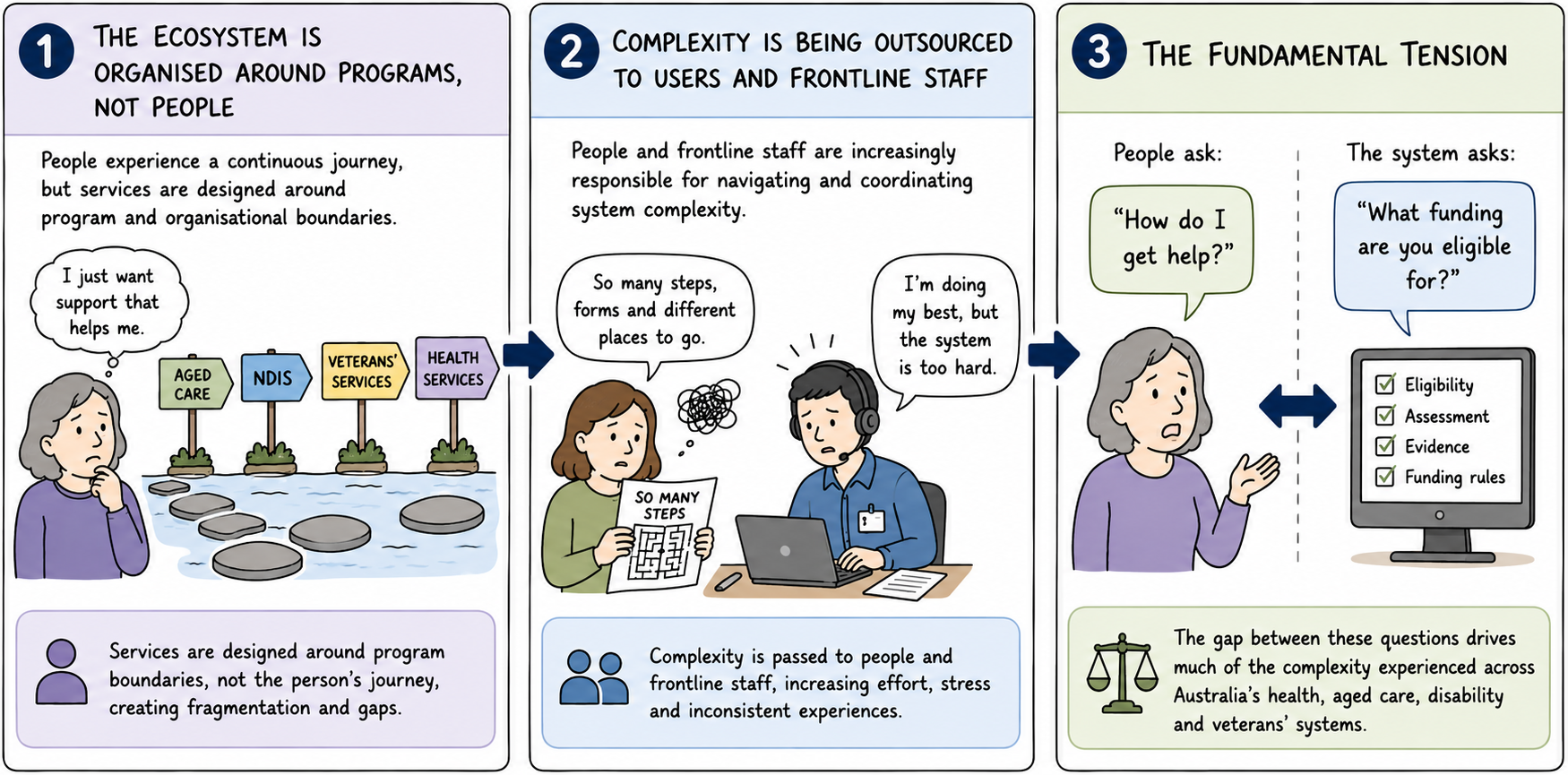
↑ Current state, high-level insights of people’s health experiences
The real outcomes: duplicated effort, weak traceability between strategic intent and frontline experience, difficulty prioritising investment, and no reliable way to see cross-agency dependencies or ecosystem gaps. Because effort was organised around programs rather than people, experiences that spanned multiple programs, which most real experiences do, have no single owner.
Task
Design a model that could:
- Map the end-to-end experience ecosystem across health, aged care and disability
- Act as a stable anchor for transformation planning, independent of org and policy change
- Remain agnostic to any single program, system or agency, so the experience, not the org chart, stayed the constant reference point regardless of which part of government was in scope
- Align human experiences to enterprise capability models and architecture domains
- Create traceability between strategic goals, digital priorities and operational initiatives
- Support future-state (“Better Future”) mapping
- Translate architecture concepts into language usable by executive, policy, architecture, delivery and HCD audiences
Action
Anchored the model in experience, not structure:
Rather than starting from org charts or capability lists, the work began by identifying the major stages people move through across the ecosystem: planning, accessing, delivering, funding, regulating and continuously improving services. Organisations, technologies and policies change; the underlying experiences people have are comparatively stable. That stability is what made the model usable across reform cycles and machinery-of-government change, rather than needing to be rebuilt every time something upstream shifted. It also meant the model held regardless of which agency, program or sector was in scope: a person’s experience of “accessing services” doesn’t stop being one experience because health, aged care and disability administer different parts of it. It kept the model from replicating the same program-based fragmentation it was built to address, and gave the ecosystem a single point people and experiences could be held accountable to, rather than accountability diffusing across whichever program happened to touch a given part of the journey.
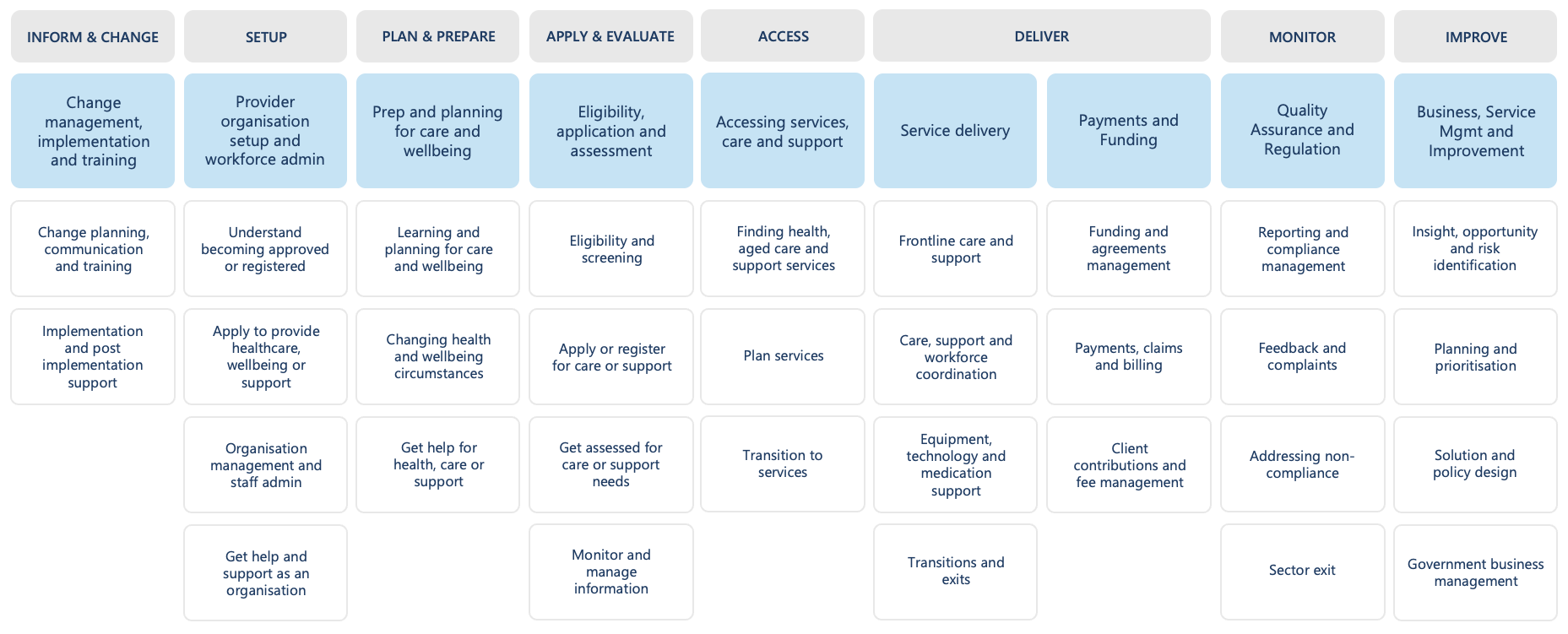
↑ Ecosystem-wide Experience Model – based on program agnostic value chains.
Positioned it as the anchor layer:
Positioned between HCD, business architecture, digital strategy, policy design, investment planning and delivery roadmaps, deliberately shifting conversations from “who owns this system” to “which experience is this improving.”
Mapped Enterprise Capability Models (ECM) to experience stages:
This meant plotting L1/L2 capabilities against each experience stage to see where capabilities served multiple experiences, where coverage was thin, and where effort was duplicated. For example, the experience stage covering accessing services, care and support drew on capabilities spanning identity, service directories, referrals, care planning, interoperability, digital channels and information sharing. Individually these appeared unrelated within the Enterprise Capability Model, but viewed through a single experience they were clearly contributing to the same outcome. Conversely, stages such as changing circumstances and transitioning between services showed comparatively little explicit capability coverage despite being consistently identified through research as high-friction experiences. This shifted conversations from whether individual capabilities were complete to whether the experience itself was adequately supported. It’s this step that turned abstract architecture artefacts into something a non-architect could actually read and use.
Connected the model to strategy (Business Motivation Model):
Linking the experience stages to strategic outcomes, objectives, tactics and investment horizons made it possible to trace a line from a government outcome down to a specific capability and back up to the human experience it served, and to ask, concretely: which experiences does this investment improve, which objectives does this capability support, and where are multiple programs solving the same problem.
Built “Better Future” state mapping:
Using the model as the base layer, the work analysed current-state pain points and developed future-state experience outcomes, focused on continuity of care, reduced administrative burden, more coordinated and inclusive experiences, simpler navigation, and better-connected data and services, rather than technology delivery as an end in itself.
↑ Target Experience Outcomes: A ‘Better Future’ of Health, Care and Support
Applied the model to investment and prioritisation.
Digital Investment Planning and roadmap work used the model to group investments by human outcome rather than by system, surface duplicated initiatives, and create continuity across 2-, 4- and 10-year horizons, shifting the investment conversation from “which systems get funded” to “which future experiences are we enabling.”
Result
The Experience Model was adopted as the primary reference structure for the Department’s Data and Digital Strategy, informing strategic planning, future-state design, investment prioritisation and implementation planning across health, aged care and disability. Many of the specific investment decisions and governance outcomes from the engagement remain confidential, but its adoption at this level reflects its value: not as another framework competing for attention, but as a stable organising layer capable of aligning disciplines (strategy, architecture, policy, delivery) that had previously worked largely independently.
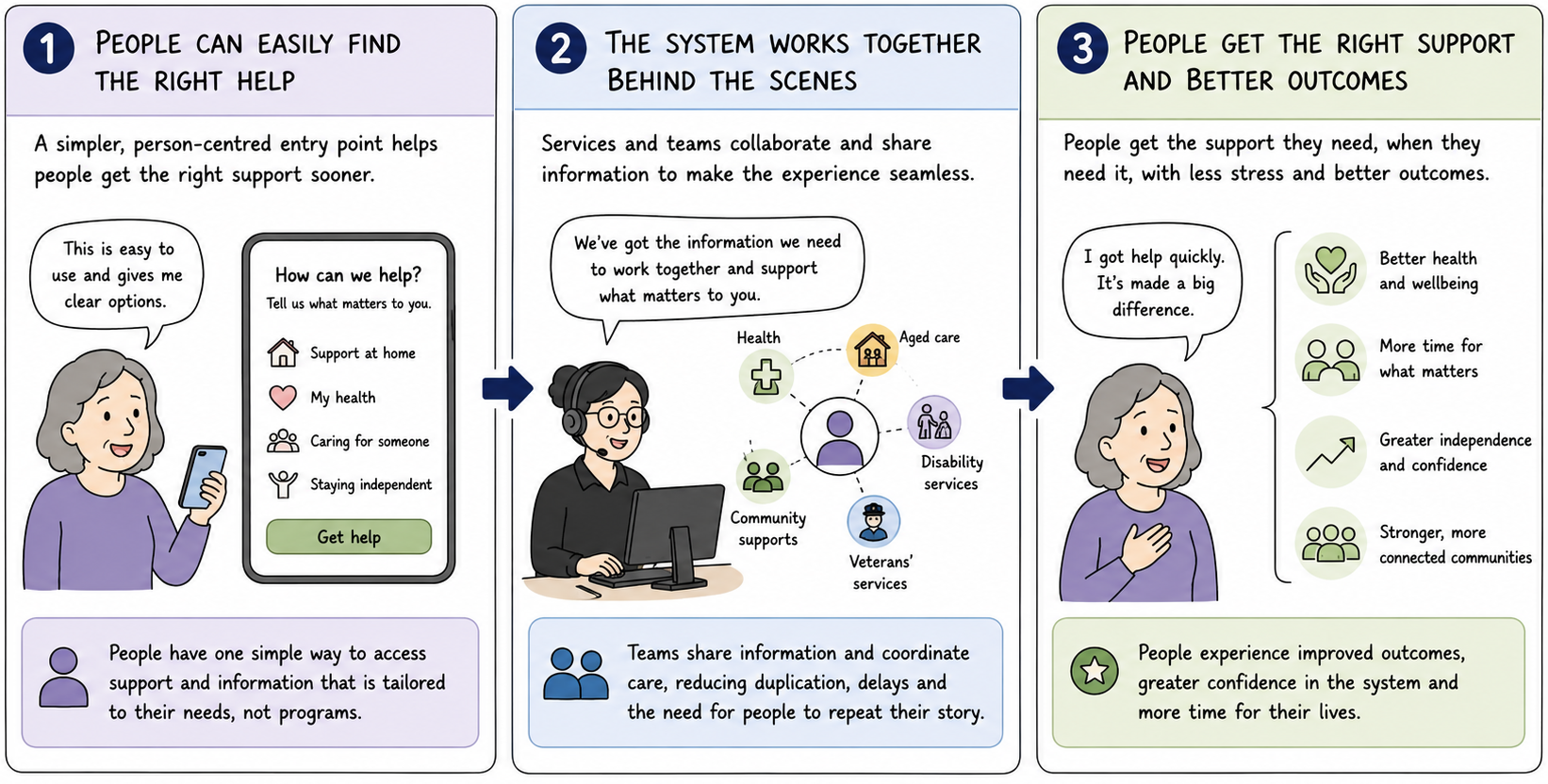
↑ What ‘Good’ looks like, for people, their families and supporters
That value showed up concretely in what the model exposed. Viewed through shared experience stages rather than organisational or program lenses, it became clear that many digital initiatives were solving similar problems independently. Identity, information sharing, notifications, consent, care coordination and reporting repeatedly appeared across multiple programs, but without a common reference point they were being planned in isolation. Surfacing that overlap opened up opportunities to consolidate investment, identify ecosystem dependencies, and avoid solving the same problem multiple times.
The model also became the foundation for multiple downstream artefacts across the engagement: the organising structure for the Business Motivation Model, future-state scenarios, strategic priorities, digital investment planning, implementation roadmaps and experience-based prioritisation. More significantly, it became the common language across service design, business architecture, strategy and executive discussions. Disciplines that typically worked from entirely different artefacts could collaborate from the same reference model.
Taken together, this repositioned business architecture and strategic transformation around human experience rather than organisational structure or technology systems. Rather than adding another framework, the model connected the existing ones (capability models, journey maps, policy domains, investment plans) into a single traceable line running from strategic intent through enterprise capabilities and investment portfolios to the lived experience of the people the system exists to serve. Teams could anchor a discussion to a single experience stage and trace the relationships in either direction, rather than repeatedly translating between disconnected artefacts. And because the model itself carried no program or sector boundary, it gave the ecosystem something rare: a single point of accountability for an experience, regardless of how many agencies or systems contributed to it.