
Overview
As service and experience designer within Westpac Group’s Business Banking Transformation program, I worked on simplifying merchant onboarding and servicing for bankers and small business customers. Merchant origination had fragmented across up to six legacy systems, manual workarounds and duplicated processes, bankers moved between all six just to onboard a merchant, manage pricing, track decisions and complete servicing. For customers, that internal complexity showed up as slow approvals, repeated information requests and general friction.
My role was to understand the service end to end, connect banker pain points to customer outcomes, and design a unified experience that could ship as an MVP while laying the foundation for future customer self-service.
Situation
Merchant onboarding and servicing had evolved across multiple platforms over many years into a patchwork of systems, workarounds and disconnected team responsibilities. Bankers routinely re-entered the same information across systems, customer visibility was fragmented, and key decisions depended on informal coordination between frontline bankers, associates, pricing specialists, credit decision-makers and fulfilment teams.
The practical effects: heavy manual rework, inconsistent processes, compliance risk from duplicated information, slow credit and pricing decisions, poor visibility of customer status, and customer-facing delays.
This wasn’t a straightforward technology replacement. The real challenge was understanding how work actually moved through the organisation, where complexity was being generated, and how a new experience could simplify the service without breaking the regulatory and operational constraints business banking runs on.
Task
Lead the service and experience design work to shape a unified merchant management platform for bankers, one that could consolidate onboarding and servicing into a single workflow, cut system-switching and duplicated effort, improve visibility of customer/product/risk/decision information, support faster and more consistent pricing and credit decisions, and ship as a deliverable MVP with a clear path to future customer self-service.
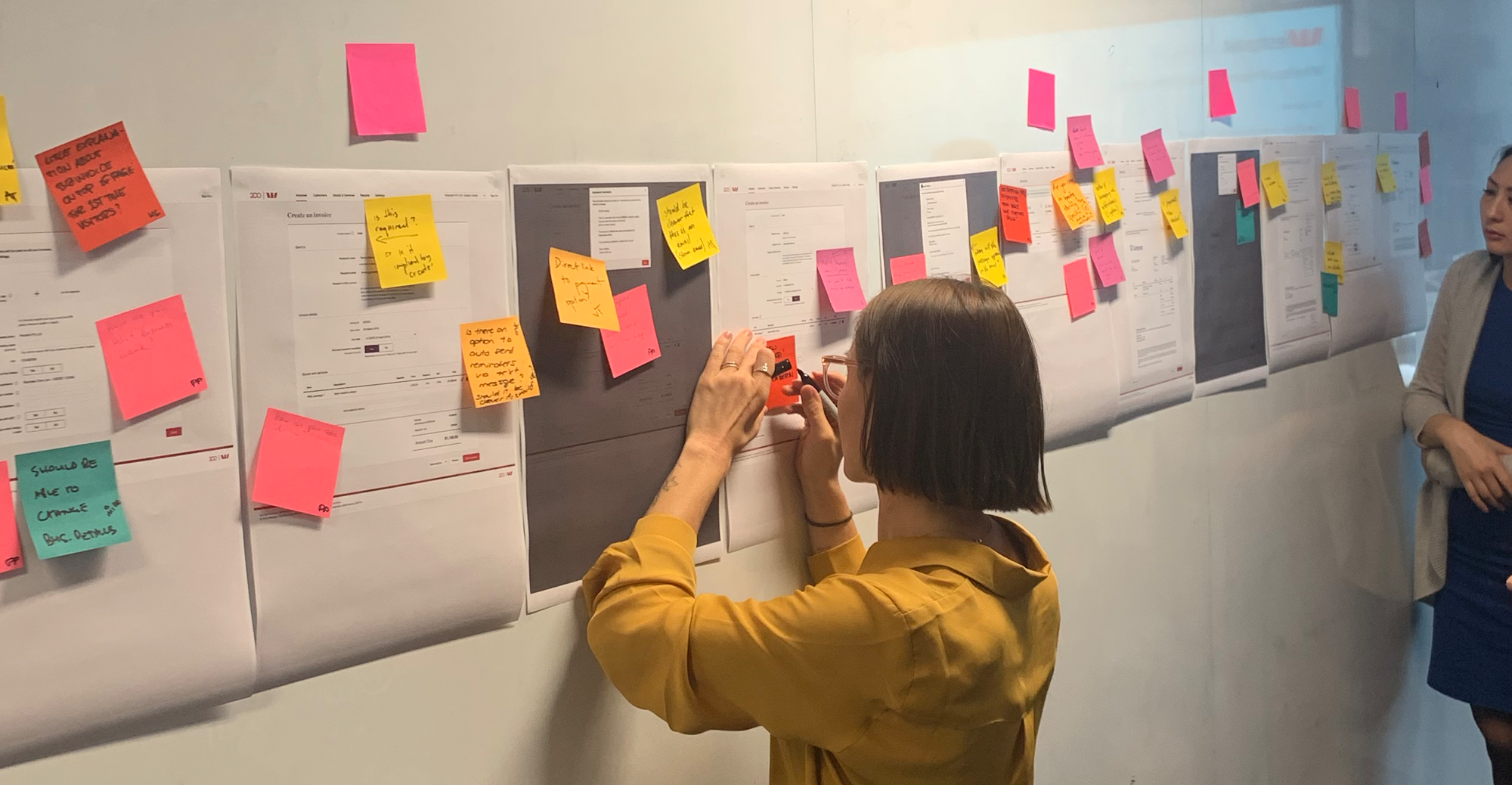
↑ HCD team workshop, early-stage experience design jam + feedback session
That meant more than interface design: clarifying the service model, simplifying workflows, aligning stakeholders around a shared problem definition, and translating operational complexity into something deliverable incrementally.
Action
Mapped the service end to end.
I mapped the current origination and servicing journey across systems, teams and customer touchpoints, including banker workflows, handoffs between bankers/pricing/credit/fulfilment, customer touchpoints, system dependencies, manual workarounds and regulatory requirements. This surfaced a distinction that mattered: slow customer outcomes weren’t only a systems problem. Unclear workflow ownership and coordination effort sitting outside formal process design were doing as much damage as the legacy tech.
Connected banker experience to customer impact.
The banker experience couldn’t be treated as a purely internal efficiency problem, when bankers searched across systems, re-entered data, or waited on other teams’ decisions, customers felt it directly as delay and repeated questions. Journey mapping and service blueprinting made these links visible: where banker effort became customer delay, where duplicated data created risk, where internal ambiguity produced poor customer communication. This shifted the design conversation from “replace the screens” to “fix the service,” and gave stakeholders a clearer basis for prioritisation.
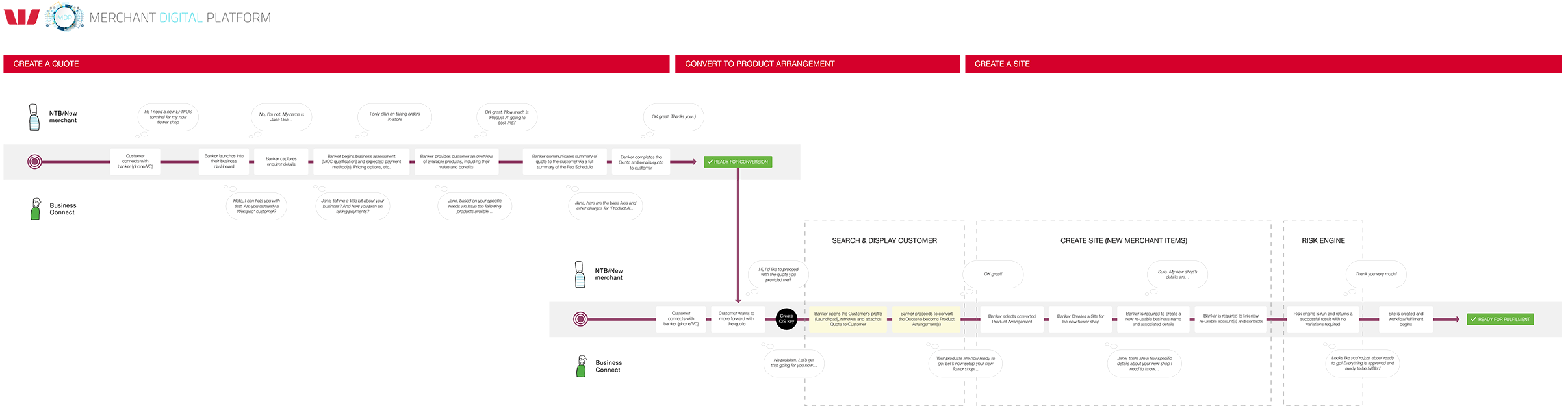
↑ Service and experience mapping, of a customer conversation and onboarding
Designed the future banker experience around tasks and decisions, not around simplicity for its own sake.
Merchant origination genuinely is complex, multiple actors, product variants, pricing, compliance checkpoints, risk requirements, long-running workflows, so the goal was organising that complexity, not hiding it. This meant defining priority workflows for MVP, sequencing origination steps to match how work actually happens, structuring customer/business/product/risk information coherently, designing status visibility across long-running applications, and building concepts and prototypes to test workflow logic. The core of this was information architecture: pulling everything a banker needed, customer details, business structure, product needs, pricing, risk, compliance, decision status, out of scattered systems and into one coherent structure bankers could act on with confidence.
Scoped a practical MVP, not an idealised end state.
Part of the job was drawing the line between what had to be solved in the first release and what belonged to a longer-term service model, balancing banker needs against delivery constraints, compliance against workflow simplicity, and MVP scope against the future self-service roadmap. Concepts were refined through stakeholder reviews and validation sessions, with the banker experience designed as one piece of a broader merchant service model rather than a standalone interface.
Result
The MVP delivered a single banker experience for merchant origination and servicing, replacing reliance on the six-system patchwork.
Approval timeframes dropped from weeks to days, the clearest measure of the impact, driven by digitising and streamlining decisions that previously depended on manual coordination and fragmented information.
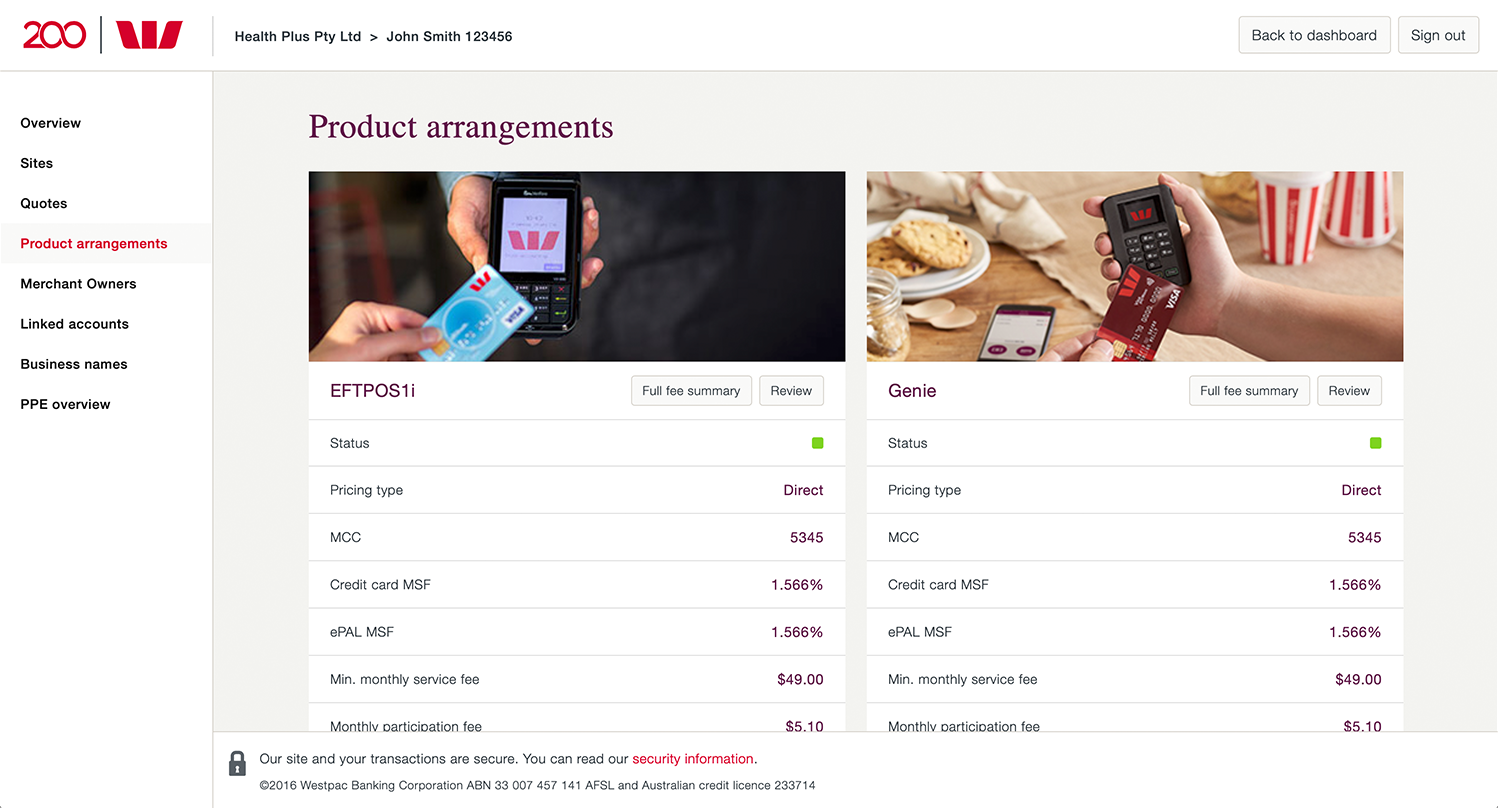
↑ Static HTML prototype of conceptual UI experience
Beyond that:
- Bankers worked in one consolidated workflow instead of switching across systems for onboarding and servicing, reducing effort and improving consistency
- Customer, business, product and status information sat in one coherent structure, so bankers could see what stage an application was at and what was needed next
- A more complete view of the merchant relationship supported better banker conversations and clearer product recommendations, customers felt the benefit of a less fragmented process even where the change was happening behind the scenes
- The consolidated origination model gave the program a structural foundation to build customer-facing self-service on top of, rather than needing to re-architect later
Summary
The core contribution was translating a fragmented operating environment into a clearer, more usable, more deliverable banker experience. The project reinforced a point that generalises beyond this engagement: in complex service environments, the interface is usually the final expression of deeper decisions about workflow, ownership, information and accountability, not the thing that needs fixing first. Mapping the service, connecting banker activity to customer outcomes, and shaping a practical MVP is what actually created a coherent foundation for merchant origination and servicing.